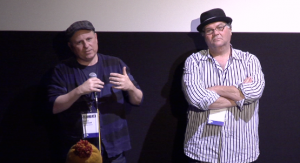
IFFBoston ’12 VIDEO: Beauty is Embarrassing Q&A

IFFBoston ’12 VIDEO: Beauty is Embarrassing Q&A

This GREAT Q&A with the amazing Wayne White and director Neil Berkeley followed the screening of the film Beauty is Embarassing at IFFBoston 2012. White goes into what it was like being filmed, and talks about collaboration and his philosophies on art.

IFFBoston ’12 VIDEO: God Bless America Q&A

IFFBoston ’12 VIDEO: God Bless America Q&A

I loved Bobcat Goldthwait’s latest film God Bless America - and I could have listened to Goldthwait talk the rest of the evening, but here’s some of the best stuff from his Q & A at IFFBoston.


IFFBoston ’12 Review: The Queen of Versailles

IFFBoston ’12 Review: The Queen of Versailles

What happen’s when you go from having anything, to not being able to afford it?

It’s easy to look at Lauren Greenfield’s documentary the The Queen of Versailles and be shocked, even disgusted at the wealth of David and Jackie Siegel. But that’s not what the film is about. Not once did I feel that Greenfield was mocking, or asking the audience to laugh at her subjects. What she was doing was painting an elaborate, detailed portrait of an extremely wealthy family. Queen of Versailles is the anti-Real Housewives of wherever – rather than romanticizing their position in life, the film does a really great job of showing them us as they are. This isn’t a caricature, it’s definitely the real deal.

The film starts as David and Jackie Siegel are in the midst of planning and designing the largest single-family home in America. Both came from humble beginnings, and in the 70s and 80s, Siegel built his empire, Westgate, a timeshare company. Jackie, his fourth wife, was former Miss Florida, and married David in the mid 90s. Together, the couple has 7 children, and have taken on an 8th, Jackie’s niece.

The home, a merger of Versailles and the top three floors of the Paris hotel in Vegas, is a 90,000 square foot structure that is the definition of luxury. The plans for the finished house have marble everywhere, gold plating, paintings, antiques, and 30 bathrooms.

The film turns from a story about living in luxury to a riches to [almost] rags tale – following the completion of the Planet Hollywood Westgate towers in Las Vegas, the bottom falls from underneath them as the sub-prime mortgage based timeshare business falls apart along with the rest of the economy.

Greenfield followed the Siegel family for two years, and it seemed like nothing was denied as far as access goes. There’s a lot of stuff that could be fairly embarrassing for the family, moments like Jackie asking what the name of her driver is while renting a car from Hertz. With limited staff at their home, the house becomes overrun with dog feces and clutter.

Should we feel bad for the Siegel’s? No, because I don’t believe that was Greenfield’s intention either. What we have here is an amazing record of just how the economic downfall affected even the most well off family. What’s it like for the super rich to have to cut back? Just as much a culture shock as it’d be for a middle class family to cut back. Just super amplified. To borrow a quote from a friend who also saw the film, if I’m ever that rich, I’ll be sure to have a rainy day fund.

IFFBoston ’12 VIDEO: Alex Karpovsky & Garth Donovan Q&A – Rubberneck

IFFBoston ’12 VIDEO: Alex Karpovsky & Garth Donovan Q&A – Rubberneck

Following the Boston premiere of Rubberneck, filmmakers Alex Karpovsky and Garth Donovan are joined on stage with the producers and other actors from the film to field questions from the Coolidge Corner audience at IFFBoston 2012.

IFFBoston ’12 VIDEO: Stephen Kessler Q&A – Paul Williams: Still Alive

IFFBoston ’12 VIDEO: Stephen Kessler Q&A – Paul Williams: Still Alive

Following the IFFBoston 2012 screening of Paul Williams: Still Alive, director Stephen Kessler talks a bit about what didn’t make it into the film, and proves to the audience that Paul Williams and him still are friends!

IFFBoston ’12 Review: Beware of Mr. Baker

IFFBoston ’12 Review: Beware of Mr. Baker

“The Devil takes care of their own,” someone proclaims in Beware of Mr. Baker. You quickly understand what that means in this fast paced, fast moving first-person documentary of Ginger Baker, the man, the myth, the legend.

Directed by Jay Bulger, who owes his career to Ginger – we fly over to South Africa to spend some intimate time with Baker as he tells the story of his sometimes outrageous past.

Bulger interviews Eric Clapton and Jack Bruce of Cream, Charlie Watts of the Rolling Stones, Johnny Rotten, and more. Baker’s career spanned many generations, from 1958 to today. The man influenced so much of what music and drumming is today, and it’s hilarious to hear his reaction when told that, exclaiming that if he’s the father of heavy metal, it “should have been aborted.” His story is told via archival footage, his friends and bandmates, old television appearances, and Ginger (though, sometimes seemingly unwilling) himself.

So how did the filmmakers get this great access? Baker, a private, and somewhat eccentric man received phone calls from Bulger a few years prior – who lied his way into contact, stating he was a reporter for rolling stone. He then went down to South Africa, and the article ended up getting published in Rolling Stone.

The filmmakers use a stylized animation to illustrate Baker’s stories – a tool they turned to when they had no other footage. It worked for them because Baker’s tales really are so outrageous, they almost sound made up. When you see the man, and how far he goes with Bulger, you know he is the real deal.

I love that the filmmakers left material in the film to show you just how difficult a person Baker was to work with. But in the end, he’s just being himself, and legitimizes the story that much more.

Despite his eccentricities, his behavior to his family and friends, one cannot deny Ginger Baker’s immense contribution to percussion, and the music scene as a whole. Remember, when you’re driving around a neighborhood and you see a sign “Beware of Mr. Baker,” you probably shouldn’t go in – you might end up with a cane to the face. So better play it safe, just see the movie instead.

IFFBoston ’12 Review: Beauty Is Embarrassing

IFFBoston ’12 Review: Beauty Is Embarrassing

Beauty Is Embarrassing ends with an amazing call to action from subject Wayne White. He sums up what he means by Beauty Is Embarrassing, and it just as equally sums up White’s entire Mantra. Do what you want to do, be who you want to be, no matter what.

Wayne White, best known for his creative work behind Pee-Wee’s Playhouse, as well as his work on the Smashing Pumpkins video “Tonight, Tonight,” has changed careers in the past 10 years. After spending the late 80s and 90s performing various tasks as art direction, set, puppet, and animation design – White has become a fascinating artist. Purchasing what he calls “thrift store” paintings, and writing interesting words on them. Ranging from prolific, to what he admits as somewhat crass. The work is unique, and when looked at closer, they just aren’t simple words. The 3D letters are added and implemented with the skill of an expert painter.

A debut film from Neil Berkley, he travels with White back to White’s hometown in Tennessee, we share some intimate moments as White looks into his past, and the hope of his future.

The story is moved along by what appears to be an evening with Wayne White – as he moves an audience along with the timeline of his career. Sharing stories from his past, and his latest artwork.

I loved the look and feel of this film, director Berkley does a great job of telling a fluid story that somehow feels like we sat for 90 minutes and listened to Wayne regale us with his life.

Beauty Is Embarrassing does an impressive job showing us the world through White’s lens. It’s colorful, full of life, laughter, and amazing opportunities.

Check out this GREAT Q&A for Beauty is Embarrassing from IFFBoston 2012

IFFBoston ’12 Review: Ai Weiwei: Never Sorry

IFFBoston ’12 Review: Ai Weiwei: Never Sorry

Ai Weiwei: Never Sorry is a powerful documentary that stays with you. Living in a free, democratic society like the United States, seeing or hearing stories like that of Ai Weiwei burn deep inside you. It is hard for us to understand when someone can’t express themselves freely without the worry that at any given moment, someone can show up at your door and hit you so hard your brain swells.

This documentary tells the story of Ai Weiwei, one of China’s leading contemporary artists. Best known for his design of the Beijing National Stadium for the 2008 Summer Olympics, and his subsequent boycott of the games. Weiwei is an artist that loves his country, but is not afraid of criticizing what he sees as wrong.

The film is the debut documentary feature from Alison Klaymen. The film paints a detailed portrait of the artist, and how he uses social media to express his feelings, and organize/mobilize his followers.

The film also chronicles his amazing struggle against the Chinese police – and shows the response from the Government when someone speaks too loudly.

Klayman’s access to Ai Weiwei is amazing, she spent a considerable time following him around while living in China as a journalist. The film also uses archival footage, and footage from Weiwei’s own underground films to tell the powerful story.

Despite being her debut film, Klaymen tells the story like a veteran documentarian. We all know/hear about China’s oppression and censorship, but I have never seen it outlined with such detail.

Winner of the Special Jury Prize at Sundance, and an official selection by many festivals across the world, I highly encourage all to seek out this important film. To find out more information about Ai Weiwei: Never Sorry, visit their website.

IFFBoston ’12 Review: Fairhaven

IFFBoston ’12 Review: Fairhaven

Fairhaven is the first feature from writer/director Tom O’Brien, and tells the story of three friends, reuniting in their hometown.

Jon (O’Brien), a former high school football star, is aspiring to be a writer, and is leaving his job assisting as a fisherman to pursue his dream. Dave (Chris Messina), is brought back to Fairhaven due to the death of his Father. Sam (Rich Sommer), is the only one in the bunch to have a child, and is divorced.

The film goes back and forth between the complexities of Dave’s relationship with his family and friends, to the challenge’s Jon is having with his impending life changes.

O’Brien’s love of Woody Allen and Robert Altman is clear by the dialogue – just about every scene is focused on dialogue. Characters will talk over each other, and everything almost has an improvised feel (whether or not it was, I’m not sure), but it still feels natural and realistic.

On the surface, the Fairhaven is a fairly simple story – however, the depth of the characters and their relationships complicates things. It takes the film longer than usual to set up where its headed, but once the course is set, its smooth sailing from there.

The film was shot mostly in Fairhaven and the surrounding towns. They did an amazing job picking great locations, every scene felt extremely natural and realistic. Almost as if they showed up, set the camera up and went. The DP did a great job pushing what was no doubt a digital cinema camera to the limit, with rich contrasts, and great lighting.

I enjoyed the film, and am definitely curious what O’Brien will do next. The film is currently seeking distribution, but with some fairly recognizable cast members, I hope the next step will come to them with ease – Fairhaven definitely worth seeking out.

IFFBoston ’12 Review: Time Zero: The Last Year of Polaroid Film

Time Zero: The Last Year of Polaroid Film is a love letter to instant photography. What seems to have started as an extended eulogy to the medium, the film evolves from various Polaroid Photographers talking about their love for Polaroid, to a chronicle of the efforts to save it from fading away forever.

Interviewing Polaroid artists, and former employees of the company, we get a great sense of the passion these people had for Polaroid and their cameras. Rather than constantly cutting between various voices, director Grant Hamilton stays with each interviewee, giving every single person ample time to reflect on, when they started using it, why they love it, and how the medium disappearing effects them.

The drawback to telling the story this way, many of the speakers echo/repeat the thoughts of others. But it is clear that the film began as a collection of voices. But as Hamilton revealed during the IFFBoston Q&A, as the closing of the plants neared, the “Impossible Project,” began. He does an amazing job capturing the grass-root efforts to keep the format alive. People truly working against all odds, all to save their format of choice.

We learn quite a bit about Dr. Edwin Land, the inventor of Polaroid instant photography. I would have loved to learn more about the company and its corporate history, but again, the film is more about the enthusiasts and artists that love Polaroid photography.

I really enjoyed the film, it’s always amazing to see how passionate people are about the photo-chemical process. Polaroid being an even more unique part of that tangible, printed photo world.

If you’re a fan of Polaroid, or even someone who has a love of photography, and preservation of the photo-chemical way – you will definitely enjoy this love letter to an art that almost went away.