Review: Unknown

Review: Unknown

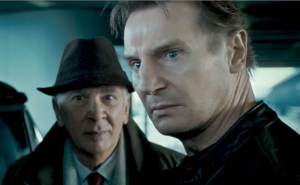
Liam Neeson: unlikely action star or unlikeliest action star?  At some point in the not too distant past, Hollywood decided that Oskar Schindler would be a pretty good candidate to drive a car backwards through the streets of various European locales while shooting guns or evading bad guys.  And so, we have Neeson starring in movies like Taken, The A-Team, and Unknown, or as I have decided to call it, Taken 2: Electric Boogaloo.  I wonder if Neeson will eventually get the action star cameo in some future installment of Stallones’ The Expendables.

Unknown stars the aforementioned Neeson as Dr. Martin Harris who travels to Berlin to attend a vague biotechnology conference.  Harris arrives at the hotel where he and his wife Liz (January Jones) are staying, only to find that his briefcase was left behind at the airport.  Thanks to lingering shots on the briefcase leading up to the realization that the case is missing, we know that this is important.  Harris immediately hails another taxi, helmed by Gina (Diane Kruger), to take him back to the airport, but is in a serious car accident on the way, leaving him in a coma for 4 days.  After coming to (and some exposition from his doctor about how his brain could be slow to recover relevant information) Harris eventually discovers that his wife does not recognize him and is in fact claiming that another man is Dr. Martin Harris (Aidan Quinn).  And lo, Unknown takes off on a wrong-man mystery as Harris 1 tries to figure out who he is, why people are trying to kill him, and the mystery that he suddenly finds himself immersed in.

For the most part, Unknown is a pretty solid film for what it is: a competent action film that crumbles as twists are revealed.  The film is engaging and interesting as Harris tries to figure out why he is no longer who he thought he was, thanks to solid direction from Jaume Collet-Serra and Neeson’s performance.  I think.  It’s hard to tell with Neeson these days.  There seems to be two Liam Neesons: one who gives his performance weight and nuance, and one who delivers dialogue with the clear enunciation of a man who has recently suffered blunt head trauma and is trying to relearn how to talk.  Schindler’s List has the former, Taken has the latter, and I think Unknown has someone who is sort of in the middle.  Neeson’s enunciation is impeccable throughout the movie, but his performance wasn’t off-putting and I found myself genuinely intrigued by Harris’s story for a while, so I have to say that Neeson was engaging.  And with a great supporting cast surrounding him (minus January Jones, whose role as Betty Draper in Mad Men seems to be an alarmingly fortunate fluke for the actress, as her line readings always sounding like line readings works well as Betty and make her seem like a disconnected actress everywhere else) including Kruger as the most attractive cab driver ever who gets caught up in the chase, and a late in the film appearance by the always welcomed Frank Langella, who arrival sadly signals the final twists and reveals that initiate the film’s third act and Unknown’s final undoing.

What Unknown is ultimately about is what really undoes the story’s competence leading up to its reveal.  As a wrong man mystery, Unknown is intriguing.  But as soon as that mystery is solved, the film becomes a silly, stock race-against-time film with Neeson the action star expertly kicking ass and taking names (and dropping the film’s dumbest piece of dialogue: “I didn’t forget everything.  I remember how to kill you, asshole.” Which, in my book, is up there with Halle Berry’s line from X-Men: “Do you know what happens to a toad when it’s struck by lightning?  The same thing that happens to everything else.”) towards the film’s neat and tidy resolution.  I obviously won’t reveal it here, but Unknown’s ending is relatively similar to the little piece of bees science talk that wrapped up M. Night Shyamalan’s The Happening.  Only in Unknown, it feels tacked on and completely unrelated to everything that just took place during the past hour and 50 minutes.

Unknown isn’t a great film, but it’s pretty competent, and will make for an excellent rainy Saturday afternoon movie on TBS.  When we’re as lost as Martin Harris, the film is engaging.  But when the mystery is revealed, I found myself wishing I was still in the dark.

Review: I Saw the Devil

Review: I Saw the Devil

Revenge may be a dish best served cold, but what if that dish never ultimately satisfies you?  South Korea-import I Saw the Devil, a film centered on a man who believes that closure for the murder of his fiancé can only come by tormenting and torturing her killer, plays with that question in a very interesting, if not perfect, way.  The film spends little time setting up our main character, Soo-hyun, and his relationship with fiancé Joo-yun, instead choosing to gruesomely dispense with her quickly, and thus setting in motion almost 2 and a half hours of pure, revenge-driven violence.

We don’t know much about Soo-hyun, only that he is some sort of special ops guy, a character point which felt added on to explain away his fighting abilities and access to a very useful tracking device.  The audience is dropped into his life moments before everything is taken from him, and we watch as the flip switches inside of him: stone-faced at Joo-yun’s funeral and looking as though he is already set on revenge, Soo-hyun is quickly on the hunt for Joo-yun’s killer, played by Choi Min-sik, who you probably recognize as the lead in one of the best revenge films out there, Oldboy.  Sure, I Saw the Devil makes momentary attempts at coloring in its characters, but those moments are few and far between, and those broad strokes don’t do a convincing job showing of us that these are real people with real motives.  The characters are pieces of a story whose purpose is to move us from the beginning to the end.

But on a certain visceral level, that’s actually ok.  The facelessness of the characters actually lends the film a hand in making an argument regarding revenge and violence upon those who have done wrong by us.  Choi Min-sik’s character Kyung-chul is a pure, unshakeable force of evil.  He is not dissimilar to Anton Chigurh from No Country for Old Men or the T-1000 from Terminator 2: soulless and able to take lumps and get back up to keep coming at you.  And he takes some serious lumps.  Once Soo-hyun discovers that Kyung-chul is the killer, he begins this game of maim and release where he shows up just as Kyung-chul is about to do something horrible and proceeds to terrorize, break, and then release his victim over and over again with a blank-faced intensity that clearly demonstrates a focused vengeance, a hope that he can visit upon his victim the same pain his victim caused.

And this game goes on and on.  At first it seems as though director Kim Ji-woon wants us to feel that action movie placation of good triumphing over evil, as Kyung-chul is always stopped just in time and served his punishment.   But as the film goes on and it becomes more apparent that Kyung-chul is not only not going to change, but actually starts to enjoy the game himself, that thrill of revenge gets diluted and we can’t help but wonder along with the film, what good is this doing?  What has changed?  Soo-hyun’s fiancé is still dead, and the evil is not only still alive, but actually growing and turning back on Soo-hyung.  And this is where we seem to find the heart of I Saw the Devil.  Our thirst for blood in retaliation for the wrongs done upon us may leave us feeling just as empty or, even worse, may end up hurting us or those we love more.  Kim Ji-woon’s carefully crafted shots show a poetry that runs deeper than just on-screen violence for the sake of titillation.  And he does a great job at showing the shifting of momentum and control as the film plays out.  Ji-woon’s direction makes it impossible to not see that the film is asking more about revenge than what is simply shown on the screen.  And that’s what makes I Saw the Devil worth viewing.

Of course, then Ji-woon seems to step away from all of those questions with a denouement that wraps things up cleverly, but seemingly contradictory to what he spent the past 2+ hours showing.  I suppose it depends on your reading of that final shot of Soo-hyung, but the resolution of the film’s chase seems to wrap things up a little too nicely, which was sort of a disappointment.  But still, I Saw the Devil is a beautiful movie with a great cast (especially Choi Min-sik) that does a good job of asking an interesting question, even if it was a bit rough around the edges.

TV Review: Veronica Mars Season 1

TV Review: Veronica Mars Season 1

I walked into viewing season 1 of Veronica Mars with very little background on the show.  Outside of knowing that it was a UPN/CW show, that it starred Kristen Bell, and that it seemed to have a pretty solid Internet following, I had nothing on the show.  (I believe, “Is that the show where she has psychic powers to solve mysteries?” was uttered in response to my wading into the first season [note: it is not].)  The curiosity thanks to the Internet fandom was enough to prompt me to fire up the series and see what the clamor was all about.

I think the best way I can describe Veronica Mars to someone is to say: if Twin Peaks and Brick had a baby, and that baby eventually went to Sunnydale High, it would be Veronica MarsTwin Peaks comes from the first season’s overarching Who Killed Lilly Kane? angle, complete with townsfolk with more going on behind the picket white fences (or the iron estate gates, as it were).  Brick because of the show’s well-defined social structure, with each group and status playing off of the other quite intelligently in a noir setting.  And Sunnydale High because it looks like Veronica is going to the same school that Buffy went to.  I suppose an even better way to describe the show is: it’s good.  Veronica Mars is a noir set in Neptune California, where Veronica (Kristen Bell) is a private investigator/high school student, working with her father, Keith Mars, (Enrico Colantoni), the disgraced ex-Sheriff of Neptune who runs his PI business and raises Veronica on his own after his wife (her mother) runs out on the family.  Why did she run out?  How does that tie into Keith Mars’s botched attempt to solve the Lilly Kane murder?  And was it actually botched?

This is the overarching mystery that unfolds through season 1 of the series, bookending each episode’s “Case of the Week” approach to storytelling.  Those cases are sometimes interesting, like “The Wrath of Con” where Veronica needs to snoop out a money fraud scandal akin to those e-mails from Nigerian princes, or “Clash of the Tritons” which has some of my favorite lines from the season, but are usually what you get through to get to the nuggets for the overarching mystery (in this sense, it is very much like watching a season of The X-Files in that the mystery of the week is sometimes cool and sometimes not, but the nuggets of the growing mythology keep us coming back).  But even in those cases, Veronica Mars does an excellent job of deepening our understanding of the characters’ stories, which lets us forgive some of the more outlandish aspects of the series (sure, the ATF would totally ask Veronica for help to ferret out a bomb threat suspect), and also helps us try to puzzle out the solution to who killed Lilly Kane.  The more we learn about the characters, the more fun we have trying to hold everyone to the light.

Those characters are interesting because they serve the stories well.  Indeed, the characters are broad arche(or stereo)types, set up for the audience to see the social classes Veronica is working with and against.  As the season moves on, we learn more about their backstories, but it always seems to be in service of the plot, not necessarily of the characters themselves.  But, as I mentioned before, it’s that development that keeps the episodes interesting.  Some of the acting is pretty wooden and doesn’t look out of place for a UPN and then The CW show, with the pretty/handsome early-twentysomethings-playing-teenagers standard we’ve all come to know and love (not to mention great guest stars, like most of the child-cast of Home Improvement and Harry friggin’ Hamlin!).  But really, honestly, this isn’t a detriment, and the writing is sharp, so even as stereotypes, they’re interesting.  There are two exceptions to this generic CW actor/acting rule and they are Kristin Bell and Enrico Colantoni.  In order for the show to work, Veronica has to work, and honestly, Bell has the character down pat.  Veronica is defensively snarky, she’s smart, and a bulldog.  Bell plays these parts pitch perfectly, and suddenly it’s forgivable that most of the other actors on the show are pretty broad and cookie cutter because Bell sells Veronica’s view so well, we’re seeing the people she interacts with the way she sees them.  And her relationship with her father, who starts off as her only support network in a place that actively hates her, is spot on, thanks in large part to Colantoni’s performance as the shamed Sheriff-turned-PI.  Those two performances and very sharp writing are the keystones to Veronica Mars’s success.

After tearing through season 1 of the series (twenty two 42-minute episodes in 1 week), I get the draw of the series.  Veronica Mars is funny, dark, a nicely balanced noir, and playfully smart.  It’s good television and like so many shows before it, appears to have been cancelled before its time.  But for now, it’s new to me and I’m already eager to dig into season 2.

TV Review: Sherlock

TV Review: Sherlock

Sherlock Holmes has become almost something of a cliché.  The deerstalker hat, the pipe, the “Elementary, my dear Watson”, the versions and revisions of the character and the stories have, over the years, greatly reduced the character from Sir Arthur Conan Doyle’s great scientific mind to something that passively conjures up a few of the notable tropes listed above or, quite possibly, a mental picture of a basset hound.  Guy Ritchie attempted to shake loose the image of Holmes with his recent cinematic take on the character, although, for my money, there wasn’t much that was particularly Holmesian about the character, instead the film was more like a chance to watch Robert Downey Jr. in an installment of the Crank series, wearing fancy clothes.  My point is Sherlock Holmes felt sort of tired and done.  Which is why all three hour and a half episodes of the BBC’s first season of the renewed series, Sherlock, was such a wonderful, wonderful surprise.

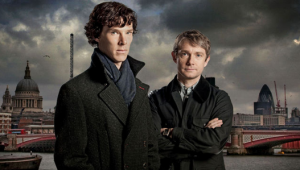
Cumberbatch and Freeman as Holmes and Watson

Sherlock takes literature’s greatest mind and moves him and his counterpart, Dr. John Watson, to modern London.  Holmes, a “consultant” for the police, takes on London’s crime puzzles using modern day technologies like texting and the Internet as he methodically works through the clues the police, and we the viewers, often overlook.  Sound like a dumb recipe for disaster, Sherlock Holmes using his Blackberry to Google things?  Well, it’s not.  And the reason why it’s not is actually one of the largest reasons why the show succeeds.  Sherlock, the character, uses these devices as tools in his arsenal to make his connections, verify his logic, and to move to the next step.  Because, at the core of the show, Sherlock is about the character, not the crimes.  This is no CSI.  Steven Moffat (the man who is currently running the latest iteration of Dr. Who for the BBC) knows what is fascinating and puts the focus of the series squarely on that: Sherlock isn’t about the audience solving the mystery along with Holmes, it’s about watching and marveling as we, one step behind the titular character, continuously play catch up with the man as he puts the pieces together.  Sure, the clues are often there, but they’re mostly alluded to subtly until Holmes pulls the mystery together for us at the very end.  Instead, Sherlock spends the first three episodes watching this character and how he develops (or doesn’t) relationships with those around him.

True to form, the audience’s avatar in this series is Dr. John Watson.  We meet Holmes along with Watson, and the series artfully uses the character to mirror the audience’s thoughts on Holmes.  At multiple points throughout the three episodes, Watson vocalizes our feelings of awe as Sherlock draws correct conclusions from seemingly innocuous details, expresses our bristling thoughts as Sherlock’s complete lack of care for people’s feelings, and at one point, during episode three, calls out Holmes’s enjoyment of “the game” when actual lives are at stake, only to have Holmes yell back a brilliant retort about heroes that perfectly sums up the character and resets Watson and the audience’s perspective on Holmes.  The season has a great arc, with the characters that are fully realized, developed (shy of maybe one or two ancillary characters [Sgt. Sally Donovan, I’m looking at you]), and grow.

Science!

But that’s not to say that the procedural mysteries that act as the catalyst for each episode are pushed aside or undercooked.  Each of the three episodes, “A Study in Pink”, “The Blind Banker”, and “The Great Game” all have gripping puzzles for our protagonist to solve.  Each story is fleshed out, and whether you find the resolutions satisfying or not (I’ll concede that I wasn’t slack-jawed at the reveal at the end of “A Study in Pink”, although the final game that was played after that reveal was yet another perfect character study of Sherlock Holmes), you can’t help but acknowledge that they weren’t haphazardly thrown together.  Everything about these stories were thought through and relayed back to the audience.  The two main characters, played by Benedict Cumberbatch (who has quite possibly the most British name ever) and Martin Freeman (from the classic BBC series, The Office) inhabit and exude Holmes and Watson, respectively.  This is truly excellent television.

If this review sounds like a loud trumpet blast touting the greatness of this series, good, that was my intention.  Sherlock truly bowled me over with how much of a total package it was.  Excellent casting/acting, producing, writing, direction, Sherlock spent its first season saying so much in only three (albeit long) episodes.  I’m already clamoring for the second season, which I hear is hitting the British airwaves come August of this year.  That season finale cliffhanger was about as nailbiter as they come.  Watch this show.

Paranormal Activity 1 and 2: Film’s Haunted Houses

Paranormal Activity 1 and 2: Film’s Haunted Houses

By all accounts, Paranormal Activity and (even more so) Paranormal Activity 2 should be Hollywood clunkers that cause us all to lament the death of the horror genre as we know it.  Two films that rely on Dolby scares to freak out the film’s protagonists who spend each film’s length splitting up (“Jesus, stay together!”), investigating strange noises in the dark (“Turn on the light!”), and peering around half-opened doors (I’m not sure what I’d yell here.  Maybe something like, “I’m coming in, bitch!” as I kick open the door and, again, turn on the light.  That’d be pretty funny.).  We’ve seen it all.  In other movies we knock the film’s final grade down a few points for relying on the Dolby scare, a loud, sudden noise that makes you jump out of your seat from the sheer fact that a noise you weren’t expecting suddenly exploded through the speakers, and for falling back on what are now the standard horror clichés.  So why the exception for Paranormal Activity and it’s successor, Paranormal Activity 2, which basically runs through the same plot points and scares as the first film?

Because make no mistake, these movies do work as horror movies.  They’re scary, they’re full of dread and anticipation, and it is all heightened by the “reality” approach to the film making, having cameras set up throughout the house or having one of the main characters walking around taping the eerie events as they unfold.  And I posit that the success of these films is exactly because we know what to expect out of them.  Both Paranormal Activities basically act like a film version of a haunted house.  (This is enhanced by the fact that the films are actually about a house that is haunted.  Whoa.  Meta.)  Remember back in the day when Halloween would roll around and a Spooky World would come into a town and set up a haunted hayride, or the town would put together a haunted house where local volunteers would dress up as mummies, look like statues, and as you were walking by, they would jump out at you?  This is exactly how the Paranormal Activity films work.  Walking in to each film, you concede as a viewer that you’re going to be scared first by what you anticipate will happen with all of the dead space.  Like walking through the door to a new room in a haunted house, each new scene in the films sends the imagination into overdrive as the eyes scan the static camera shot to find what’s “off”, to see if they can find what is inevitably out of place before a door flies open or a pan falls from to the floor.  We know something is coming.  It has to. That’s the point of the movies, to scare us by surprising us.  Just like the haunted house, we know something has to happen and the tension is built up by trying to figure out what will happen before it does.

Once that anticipation has been built, there needs to be a release.  Imagine going through that haunted house, anticipating that each statue is going to jump out at you, only to leave the room without anything happening.  The first few times will probably just ratchet up the tension because, again, something has to happen.  And if you were to walk through the last door into the gift shop selling treats and Tiny Tim CDs without any actual scares, you’d probably demand your money back.  Because you walked in for the purpose of being scared.  That’s the payoff.  The Paranormal Activity movies are the same way.  A few tension building scenes are put out there to ratchet things up, and then there’s the payoff: a Dolby scare tears through the speakers and we, the audience, jump.  We knew something was coming, but the fun isn’t knowing that, the fun is the surprise as to when and how, the same as guessing which mummy will come to life and reach out at you.

Are the Paranormal Activity films great films?  No, they’re not.  If you want to put your critic hat on, you can pretty easily break down each film to its stock of clichés and wave it off.  But that’s not the point of them.  I don’t think they’re setting out to be great films, just like I don’t think haunted houses are setting out to be great open houses.  The Paranormal Activity films are setting out to be great haunted houses, and in that, they succeed.  We enter knowing what to expect, and are gleefully excited when we get our payoff.  The show ends, we all get up and move on for another year, hearts racing and smiling.

Let Me In…As To the Whys of This Remake

Let Me In…As To the Whys of This Remake

You’ll have to forgive me ahead of time, as this write-up may turn out to be just a mental meandering as I try to come up with a rationale for why what I just watched exists.  It’s hard to find a flaw with Matt Reeves’ 2010 film, Let Me In.  It’s beautifully shot, the atmosphere and mood is dense and lingering, and the acting from principles Kodi Smit-McPhee and Chloe Grace Moretz are expectedly spot on (their respective work in The Road and Kick-Ass solidified their ability to bring character and nuance to a role [well, I suppose as much nuance as one could be expected to bring to a character like Hit-Girl]).  All of the pieces are there and they all work well.  In fact, this is an excellent film and one that I wouldn’t hesitate to recommend if someone asked.  So what’s the problem?  The problem for me is: what’s the point?  That’s the question I’ve been mulling over since I took the DVD out of my player.  You see, this is film was already made back in 2008.

Let Me In is a remake of the Swedish film Let the Right One In (which, in turn, was an adaptation of the book of the same name), and best as I can tell, it’s almost exactly the same in most respects, from mood, to set design, to dialogue, to shots, even down to haircuts.  Reeves has exorcised a few key scenes from the Swedish film; first (and mercifully) that dreadfully silly cat scene (a scene that, for me, completely disrupted the somber, heavy mood of the film) and second, the scene where Eli (renamed Abby in the American remake) reveals her/his mutilated genital area, which was a quick scene, but kind of an important one as it visually drove home the questionable androgyny of the vampire and helped put in perspective the relationship that was forming between Eli/Abby and Oskar/Owen.  Is it sexual?  Can it be sexual?  In the context of the bullying that Owen goes through in the film (and it’s pretty brutal), the relationship could be expressive of a budding homosexuality and the stigma attached to that.  All of this was expressed very well in that quick shot of Eli as s/he puts on a gown and we see the scar of what used to there.  It was impressive and important, and given the nature of this remake, it was interesting that it wasn’t there (although, given our seemingly random puritanical tendencies, I wouldn’t be at all surprised that the decision to not put that shot in there wasn’t Reeves’ decision).  But these differences aside, the only thing that really, truly separates the Swedish film from the American remake is the fact that the film is in English.  Which brings me back to why?

This isn’t the first time a film has been remade with such specific precision.  In fact, the film that came to mind as I finished watching Let Me In was Michael Haneke’s Funny GamesFunny Games was originally an Austrian film that Haneke remade in English in 2008.  A shot-for-shot remake of his original film, the only real purpose that came across as to why Haneke devoted his energy was to bring the film to an audience that it may not have reached before, due to language barriers.  Subtitles aren’t for everyone, and for those who prefer not to read while absorbing a film, a remake in an audience’s native language does allow for a film to reach a wider audience.  In the case of Haneke, he was retelling his own story and seems to want to share the film with the English-speaking world (or, I suppose, in the specific case of Funny Games, criticize Americans for their horror movie-driven lust for blood [but I digress]).  Reeves sort of seems to want to do this with Tomas Alfredson’s film, in the way that a musician may cover a smaller band’s phenomenal song, introducing an audience to music they may have never had a chance to hear of, which would explain the shot-for-shot-ness of the whole remake.  But where I get lost is that a) I don’t think Let the Right One In missed much of the audience that Let Me In would be aimed at (specifically, the vampire genre-loving folks) and b) Reeves seems to have set out to make his own film, based on the fact that he’s listing himself as the writer and director of this film, which I guess in the literal sense is factual (this is also based on the Making-Of bonus feature on the disc where Reeves distinctly notes that he is adapting the book, not the film).  If Reeves’ goal was like Haneke’s, bringing a story to an audience that it may not have reached otherwise, he might have put too much of himself into the film to actively support this as the case for the remake.  And if his goal was to put his version of the book out on film, Let Me In is so alarmingly close to Let the Right One In that this argument is almost completely invalidated.  Which, again, brings me back to: so why?

In a vacuum, were you to stumble across either Let the Right One In or Let Me In, you would not be lesser off for seeing one over the other.  Ignoring that the other exists, each film is beautiful, well crafted, and an excellent story (and excellent storytelling).  But given that they both exist, and that language is really the biggest difference between the two films, it left me lingering with the question I started with (and ended almost every paragraph of this discussion with): why?  This film experience is sort of like hearing a great story about a friend, then retelling it as if it’s your own story.  Sure, the story is great and there’s something to gain from retelling to others, but it just feels sort of, I don’t know, disingenuous in claiming it as your own.  Let Me In is a great story; I’m just not sure I understand if it’s Reeves’ story or Alfredson’s.

Justin’s 2011 Oscar Picks

Justin’s 2011 Oscar Picks

I was excited at the prospect of dusting off my Lonely Reviewer cap and jumping into the fray again by discussing this year’s top Oscar nominees and my predictions and hopefuls. If you’re going to make a triumphant return, why not dive back in during one of film’s busiest, buzziest times? Then I got the list of nominees and realized that I’m really more qualified to discuss film during its other busiest, buzziest time, tent-pole season. Damn, I missed the boat on a lot of these films in the top categories. So unfortunately, my discussion may not be the most informed (really, more Oscar nominees need to star Spider-man), but here’s a popcorn flick perspective on this year’s frontrunners.

Best Picture – Actually, of the now-exploded-to-10 list of nominees, I’ve got a pretty good beat on the category, as I’ve seen 4 of the 10 flicks (sadly, this is the best record I’m going to have for this whole discussion). To-date, I have seen Inception, The Social Network, Toy Story 3, and Winter’s Bone. Of these films, my gut, my core, the nerdiest fiber of my being wishes, nay, demands that Inception take the statue home. Was it the best film of the category? Probably not, but Hollywood should be rewarded for putting out a film that was not only innovative, gripping, and interesting, but also had mass-appeal and cultural cache for a good amount of time. Almost everyone thought this movie was great and the whole world watched and celebrated it. Should that not be the best picture of the year? Well, stifling the nerd in me for a moment, no, it probably shouldn’t. Inception was a great movie, it was well acted, well directed, well written, well shot, a beautifully executed movie, but it lacked emotional depth. It hooked you with its premise, but its hook was the puzzle, not the characters. And for a film to be the best, I think it needs to have that human element as well. Which is why my pick for Best Picture is going to be The Social Network. Here, the point of the film was the main character’s lack of emotional depth. Fincher’s film was a looking glass into the making of one of our culture’s most prevalent trends: social networking, and for a film about the creation of a website, it was gripping from a character standpoint, and it was technically subtle and brilliant at the same time (the execution of creating the Winklevoss twins was such a technical marvel and most [including myself] didn’t even realize they were witnessing something beyond what they were seeing). The Social Network had mass appeal, interesting characters, emotional depth, excellent execution, and was just a great, great movie. Come on, Academy, give Fincher his due!

Best Director – I’ve only seen The Social Network in this list, but I can absolutely see an argument for Fincher to take home the Oscar here. He’s often accused of being a cold, calculated observer in this movies, but in the case of The Social Network, it actually works, given the story and the characters. Not so much a vote for nor prediction, but I wouldn’t be displeased if Fincher took home the gold. Also, random question: How does your film get nominated for Best Picture but you don’t get nominated for
Best Director? Does the film succeed despite you?

Best Actor in a Leading Role – Again, hobbled by the fact that I’ve only seen The Social Network, this category only leaves me with the opportunity to talk about Jesse Eisenberg. Eisenberg’s performance was stellar, his delivery of Sorkin’s script was great and fun to watch. That being said, it didn’t quite strike me as an Oscar performance. I don’t think he’ll win this one. Which is probably ok, as Eisenberg is growing more and more interesting to me as an actor. I don’t think I’m ready to see him laden with an Oscar just yet.

Best Actress in a Leading Role – Of the nominees, I have only seen Jennifer Lawrence in Winter’s Bone. However, I firmly believe that her performance is the reason that Winter’s Bone has landed in the Best Picture category. Lawrence was the weight of this film and she absolutely stole the show (amongst other great performances). I would not be at all surprised if the celebration of this film ultimately came down to Lawrence on Sunday night as she accepted this award.

Best Actor in a Supporting Role – Having only seen The Town, I can say that Jeremy Renner’s performance was good and certainly captivating, but I don’t think its captivation lingered beyond the film. He served his purpose in the film and did it well, but I have to admit that I was surprised to see his name listed here. My guess is that the award will come down to either Bale or Rush. Definitely not Renner, though.

Best Actress in a Supporting Role – I have seen none of these! So I’m going to go ahead and blindly pick Hailee Steinfeld because I haven’t picked a Coen brothers-related choice yet, and I love me some Coens.

Review: Clash of the Titans

Review: Clash of the Titans

It’s sometimes hard to be a fan of big movies.  In many cases, you end up being an apologist for popcorn flicks when you say things like, “It’s ok to turn your brain off and enjoy the flashing pictures for 2 hours.”  You not only sound like an idiot who’s cool with letting the light behind your eyes dim while stale popcorn grease slowly dribbles down your chin, but you’re also extending a nacho salt-crusted hand to others, inviting them dim their watts down to 30 and let the airhead shenanigans unfold before them as well.  But the fact of the matter is: fun movies are fun!  And part of what makes some films great is that they’re just fucking entertaining.  There’s no call to dissect scenes, motivations, camera angles, lighting, whatever.  There are just fun conversations like, “That thing got blowed up real good!”  So yeah, big movies can be fun, despite their albatross of supposedly pandering to the mindless.  Unfortunately, every time we apologists take a step forward with a film like Iron Man, Hollywood knocks us back a few paces with films like Clash of the Titans.

I’m not one to throw around the phrase “cash grab”, but after dropping my 3D glasses into the recycle bin outside of the theater hosting Clash, I can’t think of any other reason that this film exists than to grab my cash.  For those living under an Olympus-sized rock, Clash of the Titans is a remake of a Harry Hamlin film that I watched in 6th grade as we younglings were learning about the Greek gods.  Sorry, let me restate that: Clash of the Titans is a bad remake of a Harry Hamlin film that I watched in 6th grade as we younglings were learning about the Greek gods.  The original Clash wasn’t a great movie by any stretch of the imagination.  In fact, outside of Ray Harryhausen’s stop-motion work, I can’t really remember anything about that movie other than the robot owl and Harry Hamlin in a toga.  So my ire for this Clash doesn’t stem from some sort of soft spot for the original, kind of a “how dare you touch this holy grail of a movie!”  No, my ire for this movie comes from the fact that the producers, and probably through trickle-down effect, the director and writers, think we the audience are total, complete idiots who will gladly fork over $13 grubby dollars to watch this in poorly rendered 3D fart on a reel.  And based on the opening weekend box office numbers, we are.  Yay?

And now, a list of evidence that Clash of the Titans is nothing but an attempt to pry dollar bills from us:

1.  Nostalgia cash-in:  This is sort of to a lesser degree as I’m not entire sure how much my generation has a soft spot for the original film, but the fact of the matter is, it fits the criteria for cashing in on our nostalgia for that magical bygone era known as “The 1980s.”  At this point, it’s a proven cash-in technique, thanks to films like Transformers, which proved that my generation is willing to get excited over the idea of something that we loved as a child is worth revisiting as an adult.  That movie really kind of did us in and we probably have it to thank for GI Joe, the upcoming A-Team movie, and Clash of the Titans.  Personally, I think I’m sort of tired of having my nostalgia played like that.  But I’m also fairly sure that I’m going to watch The A-Team.  My guess is I’ll be watching it wearily.

2.  Harry Potter-mania cash-in:  Harry Potter proved that people are willing to sit in theaters and watch movies that involve big action pieces surrounded with magic and magicians and such.  And who were more magical than the Greek gods?  The original magicians, the tricksters, a lightning bolt up your ass Zeus!  If it’s remotely magical, studios are pretty confident that a large audience will be entranced.

3.  It’s in 3D! cash-in:  Oy.  How Avatar has ruined things for us.  By now it’s relatively well documented that Clash of the Titans was a last minute rush job to convert what was supposed to be a 2D film into 3D.  The hasty work show:  people look like cardboard cutouts floating on the scenes, faces float off of bodies, and scenes are blurry and not at all blocked for a 3D representation.  I agree that a film like Clash of the Titans, with its big scorpions, swords pointing, debris flying, Gorgons slithering, could have been tailor made for an epic 3D event.  But director Louis Leterrier didn’t tailor make it for an epic 3D event.  I attended this movie with someone who had never seen a 3D movie before and was excited at the prospect.  You want to talk about being an apologist?  Try walking out of Clash of the Titans explaining how Beowulf was actually pretty good with the 3D stuff, even if it wasn’t that great of a movie to watch.  Yikes.

So yeah, the studio was clearly all about pulling your strings to get you to decide to spend $13 to see this movie instead of using those $13 for better things, like buying $13 worth of Nerds, having a Nerds-eating contest with yourself in your bedroom alone, and then throwing up $13 worth of Nerds for 3 hours, staring at the pink-brown mess accumulating in your toilet bowl while the sugar headache that is slowly pressing your left eyeball from behind gets more and more aggressive.  If their god-like trickery fooled you mortals into putting on the stylish 3D glasses, here’s what you got:

A bad, pretty action-less movie that has zero story, zero character development, and zero pacing.  The bland Sam Worthington dully plays Perseus, a boring fisherman whose family is killed by Hades, and so he somehow sort of becomes a unexciting leader of this army that he leads to, you know, clash.  With the Titans.  Except that he never actually clashes with Titans.  I think he sees Hades face-to-face twice but just sort of looks at him while Hades talks, he meets Zeus a few times but they just kind of rap with one another, the army sort of battles with these big scorpions  but that’s pretty quick and they mostly run from the danger, and for all of its hype surrounding the Kraken being released, the biggest thing that happens in the

The Kraken is pissed and is totally getting a new agent.

film with the Kraken is that it shows up.  I mean, it’s a solid 2 or 3 minutes of the Kraken arriving, so that’s

sort of action packed.  And long.  Sort of like watching a Suburban coming down the street and then parallel parking in Boston.  But man, talk about a let down.  For Christ’s sake, the Kraken was part of the film’s tagline until the studio decided to change it to “The Clash Begins in 3D!”  Maybe they did this because they knew the Kraken was quite possibly the film’s biggest non-event, so they decided to sell the movie on it being a Magic Eye that doesn’t work.  The poor Kraken.  It really needs to have a proper screen representation.  It almost had it in Pirates of the Caribbean, but writers Rossi and Elliot literally wrote its death off screen and had it just found lying dead on the beach and sort of explained away.  Now it gets this death, which I won’t spoil for you as Clash of the Titans does a good enough of job of spoiling it for you on its own.

I think I’m incredulous about Clash of the Titans because, for all of the self-made bigness surrounding it, it was clearly a bad movie that knew it was a cash grab and used a last-minute 3D conversion to horribly cloak its banal-ness.  The movie was propped up by sure-fire elements of a summer blockbuster, but rested on that, hanging the flimsiest of a story on its tent pole so that it was one minor step above watching a 2-hour reel of B footage action sequences that are usually found under the editor’s shoes.  Movies like this give the legitimately good, fun, mindless summer blockbusters a bad name, knocking us apologists back into our darkened rooms where we can unashamedly love our Terminator 2s without scorn.  Clash of the Titans is a wasted opportunity for a fun action movie involving gods, demi-gods, and man.  Even if the writers decided to ignore the amazingly rich and plentiful soil of stories that the Greeks spent hundreds of years writing to the point where it is one of the three most referenced pieces of literature (and they did ignore them), at least have the gods do something!  Nope, they just show up for about 5 minutes and don’t really set things in motion.  The only real godlike thing Zeus does is hook Perseus up with a chick that was dead.  A wasted opportunity.  You suck, Clash of the Titans.

Review: Gentlemen Broncos

Review: Gentlemen Broncos

In all likelihood, people are going to watch Gentlemen Broncos for one of two reasons: 1.) because it’s from the team that created and directed Napoleon Dynamite, a film that has garnered enough “indie” and word-of-mouth street cred for the husband-wife team to pull in an audience for another film or two (I could be wrong, but I get the impression that their second outing, Nacho Libre, may have dipped into that goodwill well or, at the very least, didn’t make the water-level rise), or 2.) because it stars Jermaine Clement, probably best-known as Jermaine from the HBO series, Flight of the Conchords.  Gentlemen Broncos seems to be the type of movie that relies on an existing fan base to gain any traction in the theater or on DVD.  The film isn’t inaccessible if you you’re in the dark on either of the two above reasons, but it is absolutely tailored to a pre-existing audience: fans of the above or people who enjoy quirky, “indie” movies that try to show a different slice of Americana’s pie.  The film’s story is as follows: Benjamin Purvis is a shy, non-descript teenage writer with a rabid appreciation for sci-fi author Ronald Chevalier.  Benjamin attends a writing camp where he submits his story, Yeast Lords, into a contest to be judged by Chevalier and it turns out that Lords is actually good enough for Chevalier, who is close to losing his publishing contract because of a string of not-so-hot book ideas, to plagiarize. Benjamin must fight to take his story back from Chevalier as well as the local filmmakers who have turned Yeast Lords into one of their films, albeit heavily rewritten.  And then Benjamin wins!  Or something.  Gentlemen Broncos‘ story actually seemed to be there more out of necessity than anything, which kind of made the film’s story (ironically about writing) feel sort of loose and unimportant.

But that’s not to say Gentlemen Broncos is a complete misfire.  It does a few things quite well.  The look of the fantasy pieces in the film (dramatic enactments of both authors’ versions of Yeast Lords) are, for the most part, spot on.  Influenced by the countless sci-fi paperback covers that lined grocery store checkouts and novelty science-toy stores  back in the 80s (you know, the painting of a hero in a silver suit shooting a laser gun at some sort of green, six-eyed alien creature peering from behind a moon rock, photon blaster in hand, all on some distant landscape watched over by three moons), Broncos’ fantasy sections look like those covers come to life: the blues are absurdly blue, the clouds are impeccably white, everything within each shot is completely lit.  Those scenes look like a print of Forbidden Planet that was punched up by a solid digital cleaning.  Another solid checkmark for the film goes to April Napier’s costume design.  Napier’s wardrobe design is a strong reminder at just how clothing can capably help set the tone for a story.  If the theater were to mute Gentlemen Broncos, looking at the costumes would give the audience a firm grasp of the characters, the general location of the film and the eccentricities that Hess was clearly trying to bring to the forefront.  And the main character, Benjamin Purvis, is sympathetic enough that you kind of want to root for him (or, at least, you certainly don’t hate him).  While the character couldn’t get more cookie-cutter insecure-protagonist-who-lost-his-father-at-a-young-age-and-finds-his-outlet-in-writing-while-surrounded-by-eccentrics-and-those-who-are-willing-to-take-advantage-of-his-insecurity-including-his-hero-turned-nemesis, actor Michael Angarano infuses enough reality in Purvis so that when scenes where half-assed love interest Tabatha (see comment about the story being “loose and unimportant”) has an obscene amount of hand lotion dumped onto the palm of her hand and she turns to Benjamin to request a hand massage, my initial reaction of “No fucking way” was tempered by Angarano’s character so that I eventually conceded, “Yeah, maybe the high school me would say ‘sure’.”

But while Purvis is appropriately likeable, the rest of the film is overly crowded with eccentrics.  Literally every character on the screen is weird, and not just in personality.  Hess populates Purvis’s life and town with outwardly strange people who, while they have just enough heart, they’re just not believable.  His mother is a fashion designer who makes horrible clothes but believes they’re great (they’re very, very clearly not: see the I Dream of Jeannie fall-wear for an example), Lonnie, the amateur filmmaker, has such an exaggerated mouth and way of speaking that just screams “trying too hard to be an oddball!”, Chevalier speaks in a weird pitch, has an odd hand gesture to say goodbye or thank you, and Dusty has long, badly permed hair, a mustache tailor-made for cruising a high school parking lot for chicks in a beat-up van with a mystical panther painted on its side, and a snake for no other reason than it’d be crazy for him to have a snake.  The list goes on.  And what’s interesting is each character is so over-the-top with their oddities that it becomes abundantly clear we’re supposed to be laughing at these small town weirdos.  Hess seems to have designed Gentlemen Broncos’ comedy around pulling the audience up to this heightened sense of self so we can all have a really good laugh at these people who are clearly beneath us.  And it just feels mean.

Which raises the question: How does a comedy work?  To make an audience laugh involves more than just throwing every nutty idea writers can think of onto the screen in the hopes receiving the coveted laughter payoff.  There’s a science, an art, to putting something on film that will register with an audience, eliciting chortles, guffaws, and uproarious laughter.  One way a good comedy pulls this off is by using the characters and/or the situations to point out things about ourselves.  Broncos seems to want to lance the idea of the small town and its inhabitants, but it doesn’t infuse enough of the small town that we all know to make what we’re watching remotely relatable.  I didn’t grow up in or ever visit a town where everyone in the general population looks or behaves like a circus retiree.  So how can we expect to laugh at our small town culture when everyone presented on the screen is so out there it’s almost absurd?  It’s too much to ask the main character to represent the audience and as a result, the audience relates to no one and misses the joke.  As contrast, look at a film like Waiting for Guffman, a Christopher Guest movie that perfectly reflects and deflates the idea of a small town and its inhabitants.  Guffman shows townsfolk who are perfectly believable and relatable, allowing the audience to see itself in the characters so that ultimately the film’s comedy comes from holding up a mirror and laughing at what we know to be true about ourselves.  Comedies can make fun of the little people if they’re willing to show that they understand and embrace the little people.  Guffman does this, Gentlemen Broncos does not.

And it’s not that a comedy needs to show a true reflection of the audience in order for it to work.  I’m hard-pressed to believe that any character Will Ferrell has ever played could be found hanging out at your town diner.  But the comedy in a film like Blades of Glory or Talladega Nights resides in the exaggeration of these overly, and unjustifiably, cocky characters Ferrell portrays.  They are so broad that they exist as almost the embodiment of a personality trait, a caricature.  They have a cockiness that makes us cringe when we come across it in real life, and the films allows us to laugh at that, to diffuse it, and to collectively acknowledge that this isn’t something we want to be.  What also makes it work is that the characters in those Ferrell movies are, on some higher level, in on the joke; they’re not trying to be sympathetic.  The audience is not supposed to feel heart towards Chas Michael Michaels.  We know that and Ferrell knows that.  The comedy comes from the absurdity and the deflation of that personality trait.  Gentlemen Broncos never presents characters that are in on the joke, so Hess ends up asking the audience to essentially spend an hour and a half having a good time at the expense of these characters solely because they’re different than us and it just doesn’t work.

In Gentlemen Broncos, Hess presents a film whose comedy just felt like bullying.  There are some legitimate funny moments in the film, mostly lines from Chevalier that were just so Jermaine (Conchords fans will appreciate the random throw-away lines that reek of Clement’s style of humor), but it made me want to re-watch season 1 of Flight of the Conchords more than anything.  This is not to say Gentlemen Broncos is an overall bad film; it’s not.  It’s a decent indie-looking film that definitely shows technical control of a craft.  Hess successfully had a vision for the film and pulled off the look.  But a bully is still a bully no matter how well dressed he is, and the film just feels mean.  And personally, I think I’m beyond using humor as a way to attack the little weirdos in our lives.  Maybe the high school me would do that, but I now prefer my comedy to be more gentlemanly.

Review: Blood Into Wine

Review: Blood Into Wine

Wine culture can seem particularly daunting to the uninitiated. The sipping, the swirling, the swishing, the spitting, all practices of an art that, for those who are used to pressing their lips to a glass for the sole purpose of having a drink for the sake of a drink, has a such an apparent high barrier to entry that it just seems easier to mock the rituals than it is to learn them. How does one even begin to understand the culture? How do you learn what you are looking for in a particular year of wine? Why take the time to learn the art? With so many people already so advanced in an art with so many nuances, where do you even begin?

Blood Into Wine, a new documentary about the development of an Arizona vineyard, suggests starting in the soil. The film follows the growth and development of Merkin Vineyards as owner/proprietor Maynard James Keenan and his partner/mentor Eric Glomski break soil in the arid Arizona town of Jerome. Keenan, for those who don’t know, is the singer for the multi-platinum bands Tool, A Perfect Circle and Puscifer and one of the film’s focuses is to bridge the gap for Keenan’s fans and followers (and, as the film shows, they’re plentiful and rabid) from Keenan the “rock star” to Keenan the viticulturalist. Keenan demonstrates that growing wine in an area that most enthusiasts and professionals don’t even know produces the libation is a labor of love and his commitment to it rivals his commitment to any of those listed musical projects. Starting as an admitted novice, the film shows Keenan, surrounding himself with those who he can glean from, as he digs in the soil, prunes vines and plays a hands-on role in each step of the process for what he hopes will one day turn his efforts into a viable entity as well as (and quite possibly more importantly) shaping his understanding of what is basically modern-day alchemy. And this is the film’s main point: patience, hard work, and commitment to an idea, whatever it is, is its own reward. “It took the world seven years to get Tool, seven years to get A Perfect Circle, and it’ll take it seven years to get this,” muses Keenan. Art takes time, regardless of what you’re creating. Fans of Tool’s music will appreciate this statement, given that the band has been around for 20 years and has 4 LPs and 1 EP to show for it.

And what about that music? No doubt the ticket-buyers to this film consisted mostly of Keenan-enthusiasts probably eager to get a glimpse of the notoriously hidden artist. To go from sparingly giving interviews, rarely having his face shown undisguised, and living in where-the-hell-is-Jerome, Arizona instead of LA (one of Keenan’s favorite punching bags) to a full-length documentary starring the man himself is probably too strong of a boon for fans of the singer to pass up, even if the film is basically about a specific kind of gardening. Blood Into Wine does touch upon Keenan’s music career (considering it was the elephant in the room, it seemed inevitable that it had to show up in the film), giving clips from Puscifer performances, interviews with Revolver’s Editor-in-Chief, and even has Milla Jovovich discussing making music with him (an ominous prediction for fans is hinted at when Keenan noted that performances would probably become a nice 2-week break from the toils of the vineyard). But unfortunately, the musical aspect of Keenan was probably the film’s weakest point. While undoubtedly interesting from a fan perspective, the film’s focus on the growth and cultivation of Merkin Vineyards is the crux of the film and the rest felt out of sync with the topic at hand. Perhaps parallels could be drawn to what Keenan has successfully cultivated and created in the past to his new endeavor, but the film doesn’t lead the viewer towards that conclusion with any sort of confidence, so the pieces about his musical career feel tacked on and slightly jarring. Interesting, but in this case unnecessary.

Indeed, this is a film about the wine and as a subject it is engrossing. Like Keenan before us, we meet Eric Glomski and are immediately impressed with his wealth of knowledge and his total sensory immersion into the craft of creating wines. To hear him discuss how 90% of what you’re tasting in a wine is actually the aroma, how he has trained his sense of smell to such a point where he can distinguish the various types of shampoos in the room, where he can smell a particular tree in a forest, is inspiring. To take something that most of us appreciate on a surface-level and approach it from a different angle is, there’s no other word that seems to fit better, neat. It’s all there already, right under our noses just waiting to be inhaled. Glomski and Keenan seem to make a perfect pair for taking on this craft; both approach the development of a wine holistically, understanding that what they are doing isn’t just a business, but an expression of themselves. “We aren’t chasing the market,” notes Glomski, and he’s right. Where the commercialization of the wine industry has been led by trends (one Napa Valley vineyard owner noted how some companies actually sell tried-and-true recipes for a successful insert-flavor-of-the-month-here to vineyards), the Arizona Stronghold (a joint venture between Keenan’s Merkin Vineyards and Glomski’s Page Spring Vineyards) revels in the creation of pleasing blends. To hear Glomski talk through tasting a wine, finding what he feels is its strengths and what it’s missing, and then thinking through what else he has tasted that could marry well and compensate is intoxicating. Glomski’s passion and incredible depth of knowledge combined with Keenan’s passion and willingness to work for it makes it hard for anyone with even a fleeting spark to create something not to their drive ignited to go work towards their goal. The film’s title suddenly becomes clear and obvious.

Will you learn a lot about the wine-making process? Blood Into Wine gives the audience a surface-level view, but don’t expect to walk away with any sort of Wine 101 knowledge. But that’s not the point. Blood Into Wine exists to show that whatever your passion or interest is, it’s going to take work to accomplish it. Anything worth doing is worth doing well and it’s going to take blood, sweat, and tears to try and get a competent command of your goal. But if you succeed, the first sip of that wine could be the most pleasing thing you’ve ever tasted, making all of your blood worth it.